Attention Rookie Oilers or Those Who Need A Refresher Course!
Oils are generally safe and can be ingested, but you should use caution! No worries – PPbyTT.blog and #YLLIFESTLYETEAM has your back! Our specialty is Oily Education!

HERE IS WHAT YOU NEED TO KNOW ABOUT HOW TO USE POTENT PLANTPOWER SAFELY AND MOST EFFECTIVELY WITH ESSENTIAL OILS!
We cannot impress enough upon new oilers is general safety when using them. This is going to be a LONG post – but please take the time to sit down and read through to the end. As you browse through various Young Living (YL) education groups, you will find terms like “neat,” “diluted,” “hot oils,” “photosensitizing,” “carrier oils”, etc. All of these are important to know before you start researching and using oils on yourself. You can never replace knowledge and common sense when it comes to health and application of any medicine, essential oils, or any other holistic healing procedures. I am only covering the very basics of essential oils here, and there is much more out there that we all need to continue to study and share.

SAFETY DISCLAIMER: All information, content and product descriptions contained within the group, blog and at our events are for reference purposes. Education is not intended to substitute advice given by a pharmacist, physician or other licensed health-care professional. We do not advise you use the information for treating a health problem or disease, or to make a self-diagnosis, without talking to your doctor. We are not medical professionals and are not in any way meant to take the place of medical advice. It is for educational purposes based off opinions and facts that we have found to be true in our own experience and with research we have gathered from books and online. We are not diagnosing, treating, or prescribing. If you have any health conditions, are on any medications, are being seen by a medical professional for any reason, are elderly, pregnant, nursing, have babies or young children or animals please consult your physician or veterinarian as well. Product packaging and materials may contain different information than shown here. Contact your health care provider immediately if you suspect that you have a medical problem. Information and statements regarding our products have not been evaluated by the FDA.
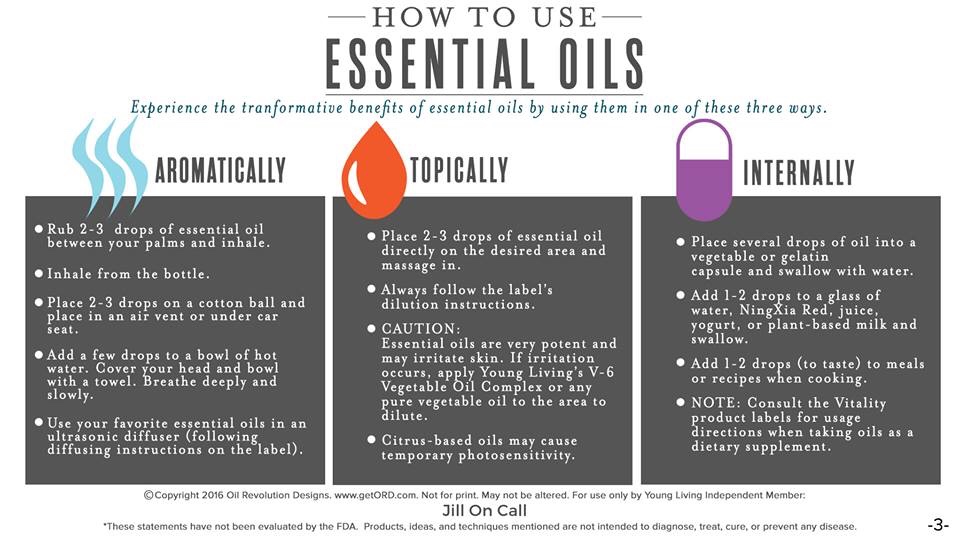
- DILUTE: When In Doubt, Dilute – Especially Oily Rookies.
- “Topically” (oils on skin) dilute with “Carrier Oil” (ex. coconut, grapeseed, vegetable oil). Carrier oils slow down the rate the body absorbs the essential oil and helps make the benefits of the oil last longer. Do Not Dilute With: shortening, butter, margarine, or petrolatum derivatives (Vaseline, Aquafor).
- “Aromatically” (breathing in) dilute with filtered/distilled water in diffuser or spray bottle.
Tests have shown, that when inhaled, oils reach the heart, liver, and thyroid in 3 seconds.
- SPOT TEST APPLICATION: Check sensitivity, apply on inner arm. Wait 10 mins for reaction or redness.
- LOW & SLOW TO START: Use low does, 1-2 drops of oil, with lots of dilution – See how you jive with oils. Do not use more than a few single essential oils or one blend when you first start out. Oils are safe but they are plants and people can be allergic to plants. When starting, do not apply essential oils “neat” (undiluted), directly to skin
- SUN SENSITIVE: “Photosensitize” oils are those that might react with skin when exposed to the sun causing a dark rash or dark pigmentation. Wait 12 hours after applying to go into sun (or apply to skin where the sun doesnt shine). Many are citrus-based, like Angelica, Bergamot, German Chamomile, Lemon, Lime, Grapefruit and Orange. Some blends, like Stress Away, contains photosensitive oils. These oils need to be kept in dark glass containers since they will react to exposure to direct sunlight or UV rays. The citrus-based oils have been known to react with plastic as well.
- HOT OILS: Some oils are “hot” oils, so you’ll always use a carrier oil Dilute!
- Plants come in many different forms and have many different properties. Consider eating a Sriracha chili versus a bell pepper. One is hot and burns your mouth; the other does not. Why is this? The oils are different.
- This is how I define the “hot” oil in my mind. If the oil is considered a hot oil, the dilution will be listed on the label so you can take precaution before application.
- Thieves, PanAway, Cinnamon, Clove, & Peppermint are Hot Oils. Lemongrass, Oregano
- KIDS: Keep Oils out of Children’s reach – they are powerful! When using topically, dilute extra on children because their skin is more permeable and absorbs the oils quickly. We recommend applying essential oils to the feet of children and babies — to provide space between the airways and the source of the essential oil.
- CHILDREN’S DILUTION RATIOS: follow proper dilution guidelines for children. For a 10mL roller bottle (Featured in Most of Our Recipes) the dilutions we prefer are as follows:
-
- For ages 2-6 years old, 3-6 drops total of essential oils, fill to top with carrier of choice
- For ages 6-15 years old, 4-9 drops of essential oils, fill to top with carrier of choice
- The KidScents line is pre-diluted for age 2 and up, but as with any of the essential oils, make sure to dilute further if skin is more sensitive.
- TO REMOVE OIL, DO NOT USE WATER: Use more carrier oil. Water will actually drive more into the skin.
- WASH YOUR HANDS: wash your hands after applying with fingertips
- EYES: Be wary of putting the oils topically near your eyes. Some oils, like Peppermint, can cause a burning sensation. If you are placing an oil near your eye, apply the oil to a Q-tip instead of tipping the bottle toward your face.
- ORIFICES: Another safety factor to be aware of is keeping oils away from your eyes and out of ear canals, nasal passages, etc.
- .PETS: Generally safe, but need to use caution. Never lock pet in a closed space with oil or diffuser. See the science behind it and certain oils to avoid around furry family. lindseyelmore.com. Pet Wellness Expert on our team Dawn of “Oh So Pretty”.
- . GRAS: An FDA term meaning “Generally Regarded As Safe”.
- . EATING OILS: All “Vitality” Oils (white labels) are Young Living (YL) dietary oils and GRAS to be ingested. Vitality oils have the same ingredients as the non-vitality, but YL label per FDA recommendation. Vitality Oils have nutritional supplement data on the back of the label with recommendations on dosage (Note: you might need to peel the outer label back to see it).
- . PREGNANCY: Most Young Living essential oils are safe to use during pregnancy, and many women have found success using the oils during and after pregnancy. However, exercise caution always and consult your healthcare professional when starting any health program. Never ever take essential oils internally if you are pregnant. Use extreme caution with topical essential oils and vaporized essential oils. Remember, essential oils very easily end up in the blood stream from topical or vaporized (and inhaled) use. Essential oils do cross the placenta and a fetus is extremely susceptible to the neurotoxic components. Most of the time this ends up being a non-issue though – pregnancy makes women so sensitive to smells that I know very few women who would use too much essential oil – our bodies do a great job of telling us when to stop!

Empower your family and equip yourself with knowledge of how to properly use #plantpower. We know safety can be a little scary and may even start to cause concern. However, you have to consider that oils require caution like any health treatment, medicine or vitamins would require. It is very important to know how to handle the oils and get the most out of them so you can keep your family healthy and happy. It’s very easy to get caught up, so if you know the basics, you can enjoy the amazing results you will see from oils. It’s just good to keep that common sense and caution in the back of your mind, so you know what to do when different situations arise.

For more Oily Education and #PlantPower Community, visit bit.ly/OILCOMMUNITY or PPbyTT.blog.

 Plants Power Purpose
One thought on “ESSENTIAL OILS SAFETY: HOW TO USE POTENT PLANTPOWER WITH CAUTION AND EFFICIENCY”